Product Description
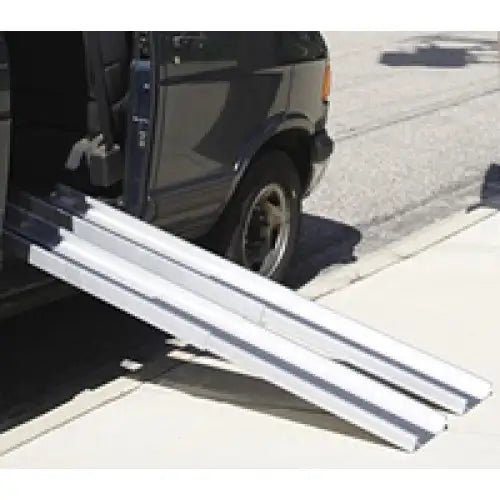
These Telescoping Wheelchair Ramps are lightweight aluminum channel-style track ramps engineered for safe, effortless access over steps, curbs, and raised surfaces — supporting up to 600 lbs while weighing just 30 lbs per pair. The telescoping design adjusts to accommodate different rise heights, making them the portable ramp solution of choice for 4-wheeled mobility scooters and wheelchairs across Canada. No assembly required; ready to deploy in seconds.
For wheelchair and scooter users, the difference between independence and requiring assistance often comes down to a single step. The channel ramp design positions two aluminum rails to align precisely with the front and rear wheels of a 4-wheeled mobility scooter or wheelchair — creating a stable, guided path over the obstacle without requiring the full coverage of a solid surface ramp. This approach keeps the ramp lightweight and manageable while delivering the 600 lb load rating and rigid aluminum construction that safety-critical mobility applications demand.
The telescoping mechanism extends the ramp length to match the rise height at hand, following the standard 1:12 slope guideline recommended by accessibility standards for ramp safety — 1 foot of ramp length for every inch of vertical rise. At 6 feet of usable length, these ramps accommodate rises up to 6 inches, covering most standard residential steps and curbs. When not in use, they collapse for compact storage and transport. Available from Factory Direct Medical, Canada’s trusted source for home care and institutional mobility equipment.
Key Features
Telescoping Adjustable Length The ramp extends and locks to multiple length positions — adjusting the slope angle to match different rise heights and ensuring the correct gradient for safe, controlled wheelchair and scooter transitions at each specific location.
600 lb Weight Capacity Heavy-duty aluminum construction supports up to 600 lbs — comfortably accommodating power scooters, heavy-duty wheelchairs, and their users without flexing, bending, or shifting under load during transfers.
Lightweight at 30 lbs At just 30 lbs for the pair, these ramps are light enough for one person to carry, position, and pack away — making them practical for daily use at home, during travel, and at multiple locations between deployments.
Channel/Track Rail Design The two-rail channel configuration positions each rail under one set of wheels — the preferred ramp style for 4-wheeled mobility scooters, which benefit from the guided wheel path of a track ramp over a solid surface alternative.
Aluminum Construction Made from high-strength, lightweight aluminum that resists corrosion and weathering — suited to both indoor and outdoor use in Canadian weather conditions without degrading, rusting, or requiring special maintenance.
No Assembly Required Deploys immediately out of the box without tools, hardware, or installation — extend to the required length, position at the step or rise, and the ramp is ready for use. Folds back down for compact transport and storage.
Telescoping Design, Lightweight Build & Safe Capacity
The channel ramp format is the appropriate choice for 4-wheeled mobility scooters specifically because the fixed wheel track of a scooter aligns naturally with the two rails of a channel ramp, providing a guided, stable path that prevents lateral drift during ascent and descent. The ramp channels have raised side walls that contain the wheels during the transition — adding a passive safety feature that solid surface ramps cannot provide in the same way. For manual and power wheelchairs, the same benefit applies: the rails guide the front casters and rear drive wheels through the transition without requiring precise steering at the threshold.
The telescoping mechanism provides a practical operational advantage over fixed-length ramps: a single pair of ramps can serve multiple locations with different step heights simply by extending to the appropriate length at each site. This eliminates the need to own and store multiple ramp lengths for different applications. At the extended 6′ working length, a 6″ step height produces a 1:12 slope — meeting the standard accessibility guideline for ramp gradient. For lower step heights, the ramp can be set at a shorter extension, producing a shallower slope that may be easier for some users to navigate. Always verify that the ramp length-to-rise ratio produces a safe slope before use.
Specifications
| Specification |
Details |
| Style |
Telescoping channel/track ramps (2-rail system) |
| Material |
Lightweight aluminum |
| Length |
6 feet (telescoping — adjustable to shorter lengths) |
| Weight Capacity |
600 lbs |
| Product Weight |
30 lbs (pair) |
| Assembly |
No assembly required |
| Primary Use |
4-wheeled mobility scooters and wheelchairs |
| Applications |
Residential steps, curbs, vehicle loading, raised platforms |
| Surface |
Aluminum channel rails with side walls |
| Use Environment |
Indoor and outdoor |
Best For
- 4-wheeled mobility scooter users who need a portable, deployable ramp solution for steps at home, at a caregiver’s home, or at frequently visited locations — where the channel rail format provides optimal guidance for fixed-track scooter wheels
- Wheelchair users and their caregivers who require a lightweight, high-capacity portable ramp that one person can carry, position, and retrieve without assistance or permanent installation
- Seniors aging in place who need to maintain safe, independent access over steps at the front or rear entrance of their home without a permanent modular ramp system
- Home care workers and occupational therapists managing clients with 4-wheeled scooters who need a portable ramp solution that travels with the client and deploys at different locations
- Families and care facilities who need a durable, high-capacity portable ramp for occasional use — vehicle loading, venue access, or covering temporary step barriers — without the cost or permanence of a modular ramp installation
Why Choose These Telescoping Wheelchair Ramps
- The telescoping design adjusts to multiple length settings, allowing a single pair of ramps to serve different step heights at different locations — more versatile than fixed-length portable ramps that require a separate purchase for each application
- At 30 lbs for the pair with a 600 lb rated load capacity, these ramps deliver an exceptional strength-to-weight ratio in the portable channel ramp category — genuinely manageable for one person while supporting the full weight of a power scooter and user
- The channel rail format with raised side walls is the preferred ramp configuration for 4-wheeled scooter users — providing guided wheel containment that solid surface ramps do not offer and reducing the risk of wheel drift during the ramp transition
- Aluminum construction resists corrosion and weathering across Canadian outdoor conditions — performing reliably in rain, humidity, and temperature variation without requiring seasonal maintenance or protective coatings
- Available from Factory Direct Medical — Canada’s trusted institutional and home care mobility retailer — with knowledgeable product support and dedicated Canadian customer service
Frequently Asked Questions
What is the 1:12 rule for ramps?
The 1:12 ramp rule means that for every inch of vertical rise, your ramp should be at least 12 inches (1 foot) long. A 6-foot telescoping ramp, for example, is appropriate for a step up to 6 inches high. This slope ratio is recommended by Canadian and ADA accessibility guidelines to ensure a safe, manageable gradient for wheelchair and scooter users. For users with limited upper body strength or a heavy power scooter, a shallower slope (longer ramp for the same rise) may be preferable. Always measure the actual rise height before selecting or positioning a portable ramp.
What is the code for a wheelchair ramp in Canada?
In Canada, wheelchair ramp requirements are governed primarily by provincial building codes and the National Building Code of Canada (NBC), with additional guidance from the Canadian Standards Association (CSA) and local accessibility legislation such as the Accessibility for Ontarians with Disabilities Act (AODA). For residential portable ramps, the 1:12 slope ratio (1 foot of ramp per inch of rise) is the widely accepted accessibility standard. For commercial or permanent installations, ramps must comply with applicable provincial building code requirements, which specify maximum slope, minimum width, handrail placement, and landing dimensions. A licensed contractor or occupational therapist can advise on compliance requirements for specific installations.
Are telescoping channel ramps suitable for 4-wheel mobility scooters?
Yes — telescoping channel ramps are specifically well-suited to 4-wheeled mobility scooters. The two-rail channel format aligns with the fixed front and rear axle widths of a scooter, guiding each set of wheels through the transition with raised side walls that prevent lateral drift. The 600 lb weight capacity covers the combined weight of most mobility scooters and their users. Before purchasing, verify that the rail spacing matches your scooter’s front and rear track width to ensure proper wheel alignment on the ramp channels. Most standard scooter axle widths are compatible with standard channel ramp dimensions.
Summary
These Telescoping Wheelchair Ramps are the portable aluminum channel ramp solution Canadian scooter users and wheelchair users choose for safe, lightweight access over steps and rises — featuring a telescoping design that adjusts to different rise heights, a 600 lb weight capacity on a 30 lb frame, two-rail channel construction with raised side walls optimized for 4-wheeled scooters, no-assembly deployment, and durable corrosion-resistant aluminum suited to year-round Canadian use.
Important Notice: These telescoping ramps are portable accessibility aids and are not intended as a substitute for permanent, code-compliant ramp installations where required by law. Always verify that the ramp length-to-rise ratio produces a safe slope (1:12 or shallower) before use. Confirm that the rail spacing is compatible with your specific wheelchair or scooter track width before purchasing. Do not exceed the 600 lb weight capacity. Inspect the ramp before each use for damage, deformation, or instability. Consult an occupational therapist for individualized ramp selection and placement recommendations.