


Medical Supply Store Near Me: A Complete Canadian Guide
By Factory Direct Medical Expert Team | April 30, 2026
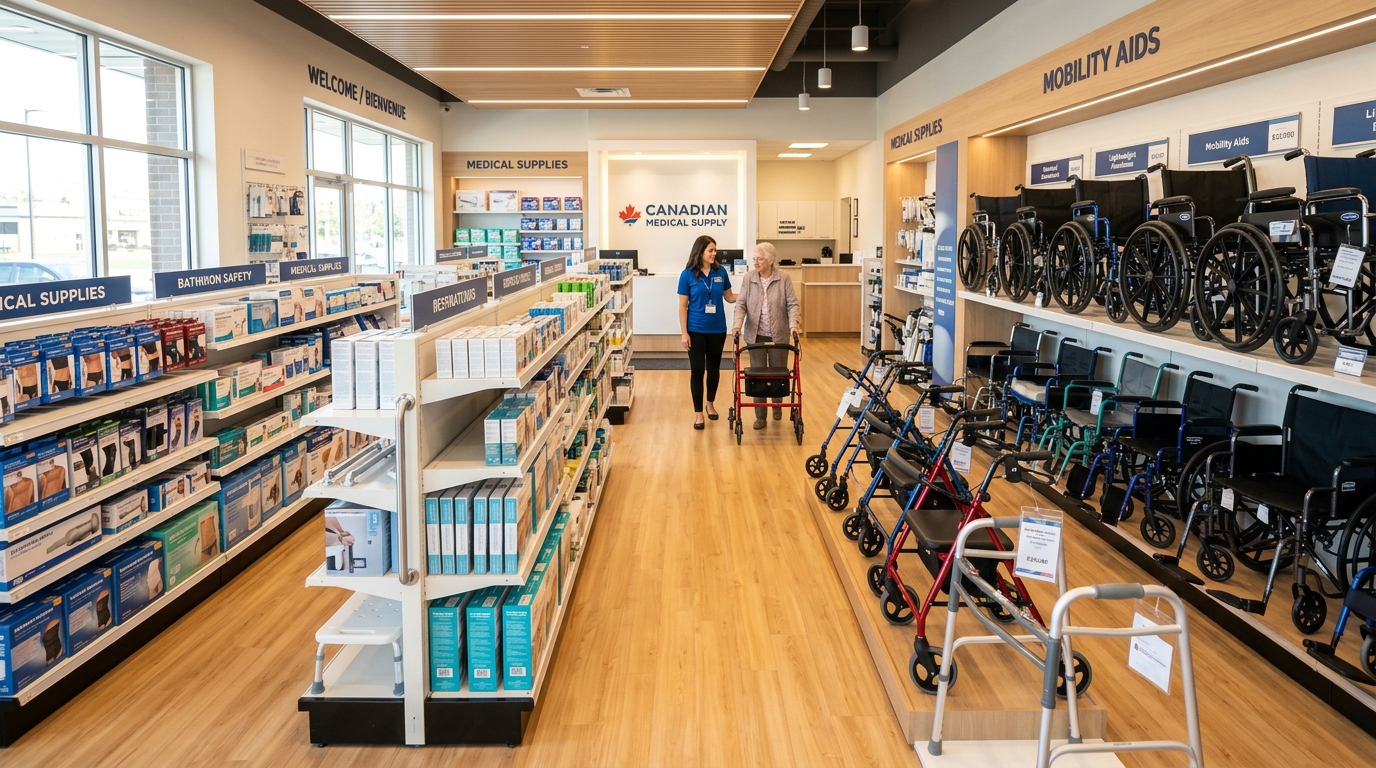
Finding the right medical supply store matters more than most people realize. Canada's home healthcare market is now valued at $17.72 billion in 2025, projected to reach $26.18 billion by 2030 (Mordor Intelligence, 2025). That growth reflects a real shift: more Canadians are managing health at home, and they need reliable equipment to do it well.
Whether you're recovering from surgery, supporting an aging parent, or managing a long-term condition, the right supplier makes all the difference. A good store stocks what you need, explains your options clearly, and helps you understand your coverage. A bad one leaves you with equipment that doesn't fit and no one to call.
This guide covers what to look for, where to find it, and how to choose a store you can actually trust.
Key Takeaways
- Canada's home healthcare market is valued at $17.72B in 2025, growing at 8.11% annually (Mordor Intelligence)
- There are 2,226 medical supply stores across Canada, but quality varies widely
- Ontario's Assistive Devices Program (ADP) covers up to 75% of approved mobility device costs
- Online retailers with physical showrooms offer the best of both worlds: convenience plus hands-on support
- Always verify that a store carries authorized products from recognized manufacturers
What Does a Medical Supply Store Actually Sell?
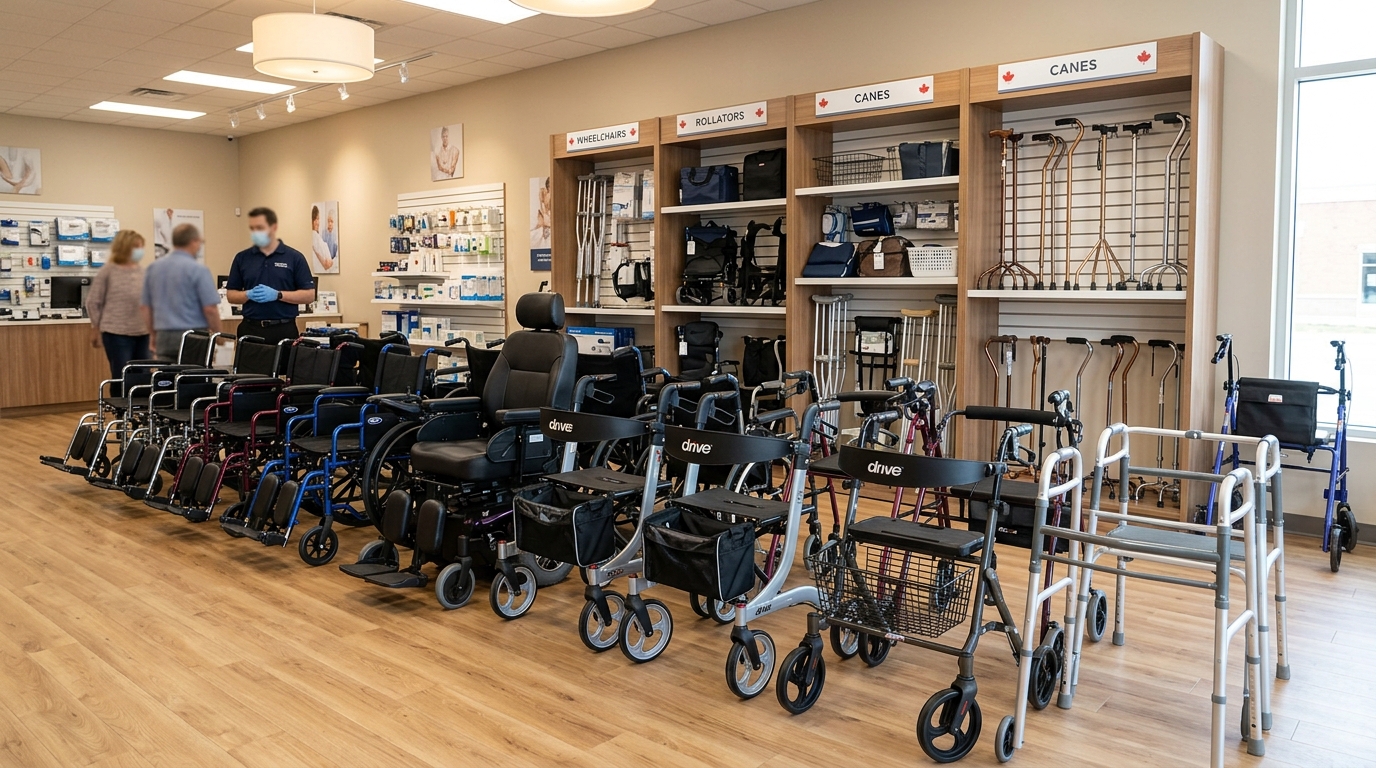
Canada's health expenditure is forecast to reach $399 billion in 2025 (CIHI, 2025), and medical supply retailers sit at the centre of that spending for everyday Canadians. The product range is broader than most people expect. It goes well beyond bandages and crutches.
A fully stocked medical supply store carries equipment across several categories. Most carry items in each of these areas:
- Mobility aids: Wheelchairs, transport chairs, walkers, rollators, canes, and mobility scooters
- Home healthcare equipment: Hospital beds, bed rails, over-bed tables, patient lifts
- Compression therapy: Medical-grade compression socks and stockings from brands like Sigvaris and Jobst
- Incontinence products: Briefs, pads, underpads, and protective underwear for adults
- Respiratory aids: Portable oxygen concentrators, CPAP accessories, nebulizers
- Daily living aids: Reachers, dressing aids, bathing equipment, adaptive utensils
- Diabetes care: Blood glucose monitors, lancets, test strips, and related supplies
In our experience helping over 50,000 Canadian customers since 1994, the most common first-time purchase is a mobility aid. Walkers and transport chairs top the list, often bought after a hospital discharge when a family has just 24 hours to prepare a home.
Not every store carries all of these. Specialty retailers focus on one or two categories. Full-service suppliers carry everything and can advise on which product category fits your situation.
Explore the full product catalogue at Factory Direct Medical to see how broad a well-stocked Canadian supplier can be.
How to Find a Medical Supply Store Near Me in Canada
There are 2,226 medical supply stores across Canada as of December 2025 (Rentechdigital, 2025). That sounds like a lot. But geographic distribution is uneven, and rural Canadians often have no store within a reasonable drive.
So how do you find one that's actually useful to you?
Start with a Google search. Search "medical supply store near me" or "home medical equipment [your city]." Review the results for stores with physical addresses, phone numbers, and real customer reviews. Don't rely on the first result alone.
Check your province's health authority website. Many provincial health ministries maintain supplier directories for funded programs. Ontario's Assistive Devices Program, for example, lists authorized vendors who can process ADP claims directly.
Ask your healthcare provider. Occupational therapists, physiotherapists, and discharge nurses refer patients to suppliers daily. Their recommendations carry weight. They know which stores have knowledgeable staff.
Consider online retailers with Canadian operations. A Canadian-based online store with a physical showroom gives you the best of both options. You can order from anywhere in the country and still call a real person for advice.
Here's something most buying guides don't mention: the quality gap between store types is wider than the price gap. A discount retailer might save you $30 on a transport chair, but if the staff can't help you measure for a proper fit, you're risking pressure sores or a return trip. The cost of a poor fit almost always exceeds the savings.
Why Online Medical Supply Stores Are a Trusted Alternative

61% of Canadians still prefer in-store shopping for health products, and 35% want to try products before buying (KPMG Canada, April 2025). Those numbers make sense. Medical equipment is personal. You want to know it fits.
But online has caught up fast. The key isn't choosing between online and in-person. It's finding a supplier who offers both.
What a good online medical supply store provides:
A proper Canadian online supplier offers free shipping coast to coast. They list real phone numbers with humans who answer. They publish detailed product specs: weight capacity, seat dimensions, folding dimensions, weight. They carry authorized products from recognized manufacturers. And they process returns without making you feel like a burden.
What should make you pause? No physical address. No phone support. Prices that seem too low for recognized brands. Vague return policies.
In our experience, customers who ordered compression stockings through a general marketplace have received uncertified products with no compression rating. Medical-grade compression garments must meet specific pressure standards. When that's absent, the product is decorative at best and harmful at worst.
Canada's compression garments market is projected to reach USD 1.77 billion by 2030 (Virtue Market Research, 2024). That growth is attracting sellers who don't understand the clinical requirements. Buying from an authorized distributor matters.
Is every online medical supply store created equal? No. And that's exactly why checking authorization status before ordering is worth five minutes of your time.
Top Products to Buy at a Medical Supply Store in Canada
46.1% of Canadian adults live with one or more chronic diseases (Statistics Canada, March 2025), and 8.1 million Canadians (19.5%) are aged 65 or older (Statistics Canada, September 2025). Those two facts explain why demand for home medical equipment is rising every year. Here are the categories Canadians buy most.
Mobility Scooters
Mobility scooters are one of the fastest-growing categories in Canadian medical retail. Three models stand out for different user profiles.
The EZee Elite Portable Scooter ($2,995) is a folding electric scooter built for seniors who need portability above all else. It folds quickly for car trunks and storage, handles typical urban terrain, and offers a comfortable upright seat.
The EZee Classic Portable ($3,595) features dual front wheels for added stability. It's the right choice for users who need more balance support or who travel on rougher surfaces. The foldable frame still fits most car trunks.
For urban users who want something compact without sacrificing comfort, the Heartway Zen S11 ($2,600) is worth a close look. It's lightweight, easy to manoeuvre on sidewalks and in elevators, and well-suited for apartment living.
Browse all options in the mobility scooters collection.
Transport and Manual Wheelchairs
Transport chairs are often the first mobility purchase after a hospital stay. Here's what's available:
- Ezee Life Transport Chair (CH1041) — $250: 17"x16" seat, lightweight aluminum frame, padded armrests, rear wheel brakes. Ideal for caregivers transporting a family member short distances.
- ProBasics Aluminum Transport Wheelchair — $250–$260: Available in Black or Pink. Slightly wider 19-inch seat, folds flat for car storage. A practical, no-fuss choice at an accessible price point.
- ComfyGo Majestic IQ 7000 — $2,795: Auto-folding electric wheelchair for users who need powered mobility without caregiver assistance. One button folds or unfolds it — a very different product from the manual chairs above, and priced accordingly.
See the full wheelchairs collection for all available configurations.
Compression Socks and Stockings
| Brand | Compression Level | Best For |
|---|---|---|
| Sigvaris (medical-grade) | 20–30 mmHg | Daily wear, varicose veins, post-surgical |
| Jobst | 15–20 mmHg | Mild swelling, travel, preventive use |
| Jobst (therapeutic) | 30–40 mmHg | Lymphedema, chronic venous insufficiency |
Both brands are available through the full product catalogue at Factory Direct Medical. Always confirm your compression level with a healthcare provider before ordering. An improper compression level can worsen certain conditions.
Does Insurance Cover Medical Supply Purchases in Canada?
Ontario's Assistive Devices Program covers up to 75% of approved mobility device costs (Ontario Government), making financial support a real option for many Canadians. Coverage varies by province, by product category, and by your specific plan. But many Canadians leave money on the table simply because they don't ask.
Here's how coverage typically breaks down:
Provincial programs. Ontario's ADP is the most well-known. It covers wheelchairs, scooters, walkers, and other mobility aids for eligible Ontario residents. Similar programs exist in other provinces under different names and with different eligibility criteria.
Private insurance. Most group health benefit plans include a "durable medical equipment" or "medical supplies" category. Coverage limits vary widely. Some plans reimburse 80% up to a dollar cap; others require a letter of medical necessity from a physician.
Veterans Affairs Canada. Veterans may be eligible for full coverage of approved medical equipment through VAC benefits.
Diabetes devices. 30% of Canadians have diabetes or prediabetes (Mordor Intelligence, 2025). Provincial programs like Ontario's ADP cover some diabetes devices. Private insurance typically covers supplies like test strips and lancets.
What to do before you buy. Call your insurer and ask for the exact product code they require. Ask your doctor for a letter of medical necessity if required. Confirm that your chosen retailer is an authorized vendor for your province's funding program. Then order.
Does your employer benefits plan cover compression socks? More often than people expect, yes. It's worth checking. The documentation is straightforward and the reimbursement can be meaningful.
What Makes a Medical Supply Store Trustworthy?
Trust in a medical supply retailer isn't built on marketing. It's built on specifics. With 2,226 medical supply stores in Canada (Rentechdigital, 2025), the range in quality is significant. Here's what separates reliable suppliers from the rest.
Authorized distributor status. Trustworthy retailers carry products from recognized manufacturers and can prove it. Ask whether they're an authorized distributor. Brands like Sigvaris, Jobst, EZee Life, ProBasics, and Mobb work through vetted channels. Unauthorized resellers can't guarantee product authenticity or warranty support.
Real contact information. A physical address and a working phone number matter. If a website has no address and no phone line, that's a warning sign. A store serving Canadians should be reachable by Canadians.
Knowledgeable staff, not just order processors. Can they tell you the difference between a transport chair and a self-propelled wheelchair? Can they explain mmHg ratings for compression? If staff can't answer basic clinical questions, you're on your own after the sale.
Clear return and warranty policies. Medical equipment should come with a clear return window and warranty. Read the policy before buying. A reputable store stands behind its products.
Verifiable customer reviews. Look for reviews on Google, not just on the store's own website. A 4.9/5 rating from 5,000+ verified customers tells a different story than 12 anonymous reviews on a homepage.
Factory Direct Medical has served over 50,000 Canadian customers since its founding in 1994. The company maintains a 4.9/5 rating across more than 5,000 verified reviews, holds authorized distributor status for Sigvaris, Jobst, EZee Life, ProBasics, Atto, Mobb, and MHWC, and operates a physical showroom in Concord, Ontario for customers who prefer an in-person visit.
You can reach Factory Direct Medical directly at 416-739-8393, or visit the About Us page for more background on the company.
Frequently Asked Questions About Medical Supply Stores
Choosing the Right Medical Supply Store in Canada
Canada's healthcare needs are changing fast. With 8.1 million Canadians aged 65 or older (Statistics Canada, 2025) and nearly half of all adults managing a chronic condition, the demand for reliable home medical equipment will keep growing. A good medical supply store meets that demand without complicating your life.
What matters most in a supplier? Authorized products. Real support. Transparent pricing. Clear coverage guidance. And someone who picks up the phone.
For Canadians outside a major urban centre, a well-run online retailer with a physical base and real customer service is often the most practical answer. Free shipping, live phone support, and a broad catalogue beat driving two hours each way to a specialty store.
The full product catalogue at Factory Direct Medical covers everything from mobility scooters and wheelchairs to compression therapy and incontinence supplies, all with free Canada-wide shipping. Questions before ordering? Call 416-739-8393. The team has been helping Canadians make the right equipment decisions since 1994.
Written by the Factory Direct Medical Expert Team. Factory Direct Medical has served over 50,000 Canadian customers since 1994, with a physical showroom in Concord, Ontario and free shipping across Canada. The team includes certified fitters and mobility specialists who assist customers with product selection, insurance claims, and equipment setup.


