


How to Choose the Right Walker for Seniors: A Complete Canadian Guide
- What Types of Walkers Are Available for Seniors?
- Standard Walker vs. Rollator: Which Is Right?
- How to Properly Fit a Walker for a Senior
- Key Features to Look for in a Senior Walker
- Top Walker and Rollator Picks from Factory Direct Medical
- Provincial Funding Programs for Walkers in Canada
- Walker Safety Tips Every Senior Should Know
- Frequently Asked Questions
More than 1 in 4 Canadians over age 65 uses a mobility device. Picking the wrong one doesn't just mean discomfort — it can actually increase fall risk. A walker set too high throws off posture. A rollator given to someone who needs to lean causes instability. The choice matters, and most buying guides skip the part that matters most: matching the device to the person.
This guide cuts through the confusion. You'll learn every walker type available in Canada, how to size and fit one correctly, which features actually matter, and how provincial programs can help cover the cost.
- Walker users experience 73% fewer falls than unassisted seniors with mobility limitations (Science in Health, 2025)
- Five walker types serve different needs: standard, 2-wheel, 4-wheel rollator, upright, and bariatric
- Proper fit requires the grip height to align with your wrist crease, creating a 15–20° elbow bend
- Ontario’s ADP covers up to 75% of approved mobility device costs for eligible residents
- Factory Direct Medical carries walkers from $75 CAD with free shipping across Canada
What Types of Walkers Are Available for Seniors?
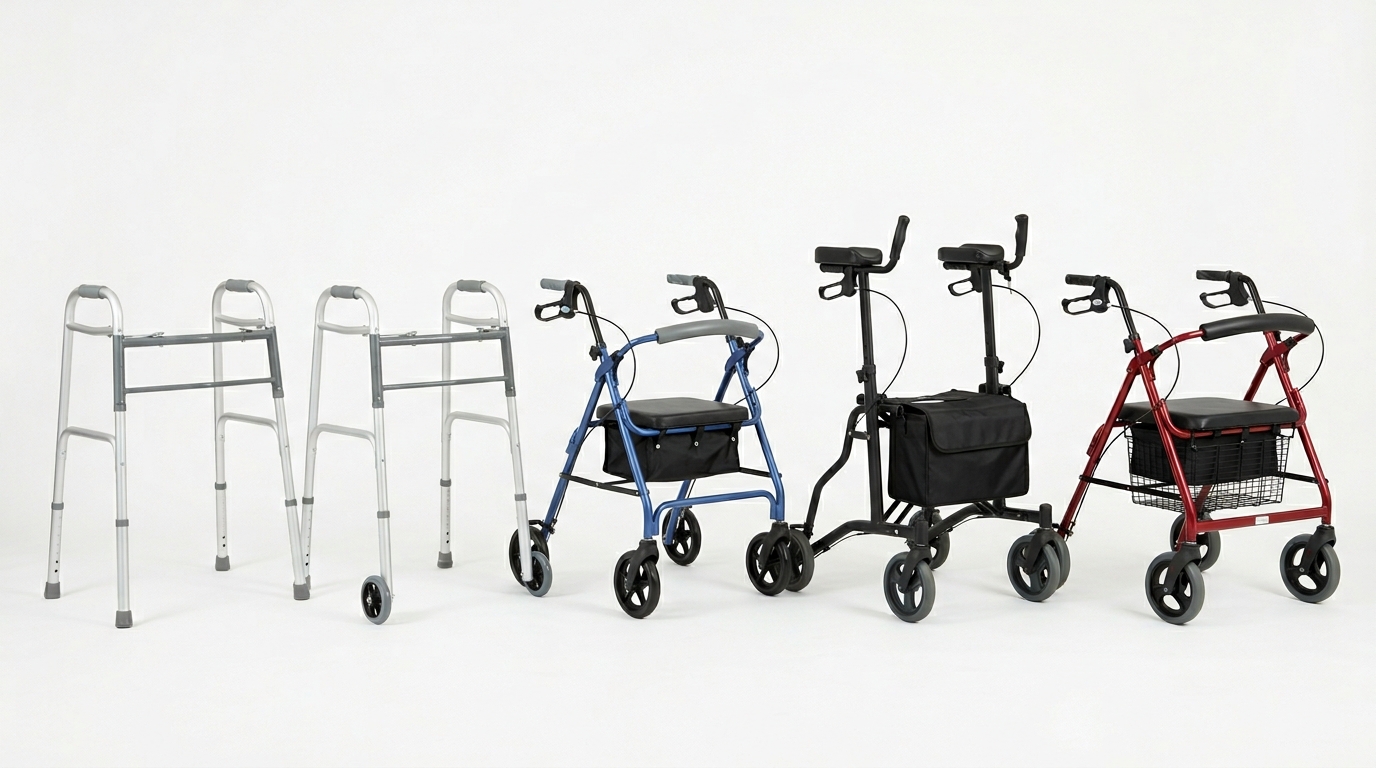
The rollator segment held 55.13% of the global walker market in 2023, and the entire elderly walker market is projected to reach $2.73 billion USD by 2032 at a 6.44% annual growth rate (GlobeNewswire / S&S Insider, 2025). That growth reflects how much variety now exists. Understanding the five main types is the starting point for any smart purchase.
Standard (4-Leg) Walker
A standard walker has four rubber-tipped legs and no wheels. You lift it, move it forward, then step into it. It offers the highest level of stability and is ideal for seniors recovering from hip or knee surgery, those with significant balance impairment, or anyone who needs to put most of their weight on the device. The deliberate lift-and-place motion naturally slows gait, which is often safer during recovery.
Two-Wheel Walker
Two wheels on the front legs, rubber tips on the back two. You glide it forward rather than lifting it. It's a middle-ground option: easier to use than a standard walker, but still offers rear stability through the back tips. Many seniors transition to this type when a full rollator feels too advanced but a standard walker feels too slow.
Four-Wheel Rollator
The most popular type globally, a rollator rolls continuously on four wheels and includes hand brakes, a padded seat, and often a storage pouch. It doesn't require lifting, makes outdoor use practical, and allows seniors to pause and rest. A rollator should not be used as a weight-bearing device the way a standard walker can; it's designed for balance support, not full load-bearing.
Upright / Posture Walker
Upright walkers position the forearms on padded arm rests at elbow height, eliminating the forward hunch common with standard walkers. They suit seniors with lower back pain, Parkinson's disease, or posture difficulties. They're heavier and bulkier, but can dramatically improve comfort for the right person.
Bariatric Walker
Built for users requiring weight capacities above the standard 250–300 lb range, bariatric walkers and rollators use reinforced frames and wider bases. The EZee Life Bariatric Rollator supports up to 400 lbs. Never use a standard walker if it exceeds its rated capacity — frame failure is a serious fall risk.
Standard Walker vs. Rollator: Which Is Right?
Walker users experience 73% fewer falls than unassisted seniors with comparable mobility limitations, and proper selection is what makes that statistic meaningful (Science in Health, 2025). The wrong device can reverse that outcome entirely.
The core tradeoff is stability vs. mobility. Standard walkers win on stability. Rollators win on ease of movement and outdoor versatility.
| Factor | Standard Walker | 2-Wheel Walker | 4-Wheel Rollator |
|---|---|---|---|
| Weight-bearing | Full | Partial | Not designed for it |
| Lifting required | Yes | No | No |
| Outdoor use | Limited | Moderate | Excellent (8"+ wheels) |
| Built-in seat | No | No | Yes |
| Speed of movement | Slow | Moderate | Fast |
| Best for | Post-surgery, severe balance issues | Transition users | Active seniors, longer distances |
| Price range (CAD) | $75–$90 | $80–$120 | $209–$425+ |
Choose a standard walker if: The senior needs to put significant body weight on the device, is recovering from surgery, or has severe balance problems.
Choose a rollator if: The senior can walk independently but needs balance assistance and rest stops, will use it outdoors, or walks longer distances regularly.
One thing our mobility specialists at Factory Direct Medical consistently observe: seniors are often given rollators when they should still be using a standard walker. The reasoning is usually "the rollator looks easier." It is easier to push, but if the user leans heavily on it, the wheels can roll away unexpectedly. Match the device to the actual mobility level, not the preference for convenience.
How to Properly Fit a Walker for a Senior
An improperly fitted walker forces an unnatural forward hunch or overextended reach, both of which increase fall risk. The correct grip height aligns with the wrist crease when arms hang naturally at the sides, creating a 15–20° bend at the elbow during use.
Follow these steps:
- Stand tall in normal shoes. Posture affects the measurement. Slouching produces an incorrect number.
- Let arms hang naturally at the sides. Don't bend them. Don't hold them stiff.
- Mark the wrist crease. The top of the walker grip should sit exactly at this height.
- Adjust the walker. Most aluminum walkers have push-button height adjustments on each leg. Set all four legs to the same measurement.
- Test the elbow angle. Place hands on grips and confirm a comfortable 15–20° bend. Straight arms mean the walker is too tall. A sharp bend means it's too short.
- Walk 10 steps on a flat surface. Check for shoulder shrugging (too tall) or forward leaning (too short).
- Test on carpet and a threshold. Indoor surfaces vary. Rubber tips should grip carpet without catching.
For rollators, apply the same wrist-crease method to the handlebar height. Then test the brakes: grip them firmly and verify the wheels lock before sitting on the seat.
Folding mechanism check: If buying a folding walker, practice the open/close sequence before the senior uses it independently. One-button folding walkers (like the EZee Life CH1082) are significantly easier for seniors with reduced hand strength than two-button models.
Key Features to Look for in a Senior Walker
Carbon fiber walker sales grew 65% in 2025 as active seniors prioritized lightweight portability (GlobeNewswire / S&S Insider, 2025), but material choice is just one of several features worth evaluating carefully before purchase.

Weight and Frame Material
- Steel frames are durable and affordable but heavier (4.5–6 kg typical for rollators)
- Aluminum frames balance weight and cost (most walkers in the $75–$325 range)
- Carbon fiber is the lightest option but costs significantly more ($995+)
A lighter walker is easier to fold, transport, and lift into a vehicle. For seniors who drive, this matters enormously.
Wheel Diameter
- 6-inch wheels: fine for smooth indoor floors, struggle on pavement cracks or gravel
- 8-inch wheels: the standard recommendation for outdoor Canadian use
- Larger wheels roll over uneven terrain more smoothly
Folding Mechanism
One-button folding (like the EZee Life line) suits seniors with arthritis or limited grip strength. Two-button systems add a safety lock but require more hand dexterity. If the user can't reliably operate the folding mechanism, they often leave the walker open in tight spaces, creating a trip hazard.
Grip Ergonomics
Look for ergonomic contoured handles over round PVC grips. Contoured handles distribute hand pressure more evenly, reducing fatigue during longer walks. Foam padding is more comfortable than bare plastic in cold Canadian climates.
Accessories
- Storage pouches and baskets add independence (groceries, medications, water bottle)
- Walker trays are useful for seniors carrying items between rooms at home
- Ski glides attach to the rear legs of 2-wheel walkers for smooth indoor gliding on hardwood
Weight Capacity
Standard walkers typically support 250–300 lbs. Always confirm the product spec. For users above 250 lbs, verify the exact rated capacity or choose a bariatric model.
Top Walker and Rollator Picks from Factory Direct Medical
Factory Direct Medical has served Canadians for over 30 years with a 4.9/5 average rating from more than 5,000 reviews, and carries walkers starting at $75 CAD with free shipping across Canada. Here are three strong options matched to different needs.
EZee Life 1-Button Folding Walker CH1082 — Best for Indoor Use and Recovery
The CH1082 is the starting point for seniors who need maximum stability at an accessible price point. It's a standard folding walker with a one-button collapse mechanism, making it straightforward to store in tight spaces. The PVC hand grips are available with wheel or wheel-plus-ski configurations, giving some indoor glide without sacrificing the rear stability that surgery recovery demands. At $75 CAD, it's the most affordable entry into reliable support. View the EZee Life 1-Button Walker at Factory Direct Medical.
EZee Life Lightweight Steel Rollator CH3017 — Best for Active Outdoor Seniors
The CH3017 suits the senior who walks independently but benefits from a rest stop and prefers a European-design four-wheel walker with genuine outdoor capability:
- European-inspired frame design for clean aesthetics and structural reliability
- Weight: manageable steel frame at $209.99 CAD
- Built-in hand brakes for confident stopping on slopes
- Padded seat for rest breaks during longer outings
- Storage pouch included
- Ideal for: community walks, shopping, medical appointments
Browse the rollator collection to compare this model against other four-wheel options.
EZee Life X Frame CH3011 vs. ProBasics Deluxe — Best for Seniors Who Rest Frequently
| EZee Life X Frame CH3011 | ProBasics Deluxe Aluminum | |
|---|---|---|
| Price | $245 CAD | $245 CAD |
| Wheel size | Standard | 8-inch |
| Seat | Padded | Padded |
| Frame | X-frame (compact fold) | Standard fold |
| Best for | Tight indoor spaces, compact storage | Outdoor use, uneven terrain |
Both models cost the same. Choose the CH3011 for seniors who primarily use the rollator indoors and need compact fold dimensions. Choose the ProBasics Deluxe if most use is outdoors on Canadian pavement, where the 8-inch wheels provide noticeably smoother travel.
Provincial Funding Programs for Walkers in Canada
Ontario's Assistive Devices Program (ADP) covers up to 75% of the approved cost of a prescribed mobility device for eligible Ontario residents (Ontario ADP). This is among the most generous provincial programs in the country, and many eligible seniors never claim it simply because they don't know it exists.
Ontario — Assistive Devices Program (ADP)
- Covers 75% of the approved cost for eligible devices
- Requires a physician or authorized prescriber referral
- Applies to walkers, rollators, and other mobility aids meeting ADP criteria
- Applications submitted by the registered vendor
British Columbia — PharmaCare
- BC’s PharmaCare programs offer limited coverage for specific mobility devices
- Low-income seniors may qualify under Plan C (Fair PharmaCare)
- Check BC PharmaCare for current eligibility
Alberta — Aids to Daily Living (AADL)
- Alberta’s AADL program covers approved mobility aids for eligible residents
- Funding level depends on income and device type
- Details at Alberta AADL
Quebec — RAMQ
- The Régie de l’assurance maladie du Québec covers some mobility devices for qualifying residents
- Eligibility criteria vary by device category
- Details at RAMQ Assistive Devices
Private insurance plans and Veterans Affairs Canada also offer mobility aid coverage. Always submit a claim before paying out of pocket.
Walker Safety Tips Every Senior Should Know
Proper walker use reduces hospitalization rates by 48% among post-surgical patients (Science in Health, 2025). That benefit disappears if the walker is used incorrectly or poorly maintained.
Six Essential Safety Rules
- Never carry the walker. Always keep it on the ground. Seniors sometimes lift a walker to move faster, which defeats the purpose and creates imbalance.
- Don't reach too far forward. The walker should stay close to the body. Overreaching shifts the center of gravity and risks tipping.
- Always check brakes before sitting (rollators). Engage the hand brakes fully before using the seat. Test them on a slight slope.
- Replace worn rubber tips immediately. Worn tips lose grip on tile and hardwood. Replacements are inexpensive and available at most pharmacies. Check tips monthly.
- Adjust for footwear. Shoe heel heights affect the correct walker height. Re-check height if the senior switches between slippers and outdoor shoes.
- Avoid thick rugs and uneven thresholds. Standard walkers can catch on rug edges. Remove loose area rugs in main walking paths.
Terrain Awareness for Canadian Conditions
Ice and snow present real hazards for walker users. Rollator wheels can slip on ice. Some seniors attach winter glides or ice-tip attachments to standard walker legs for added grip in winter months. Indoors, check that your local pharmacy, grocery store, and clinic have smooth floor transitions at entrances.
When to See a Physiotherapist
A physiotherapist can assess gait, recommend the right device type, and provide formal fitting. Many provincial health programs cover physiotherapy assessments. This is especially important after a fall, after surgery, or whenever the senior's mobility status changes.
Frequently Asked Questions
What is the best walker for a senior with balance problems?
A standard 4-leg walker without wheels offers the highest stability for seniors with significant balance impairment. It requires lifting with each step, which slows gait and forces deliberate movement. For moderate balance issues, a 2-wheel walker is a suitable middle ground. A rollator is not recommended for seniors who need to bear weight on their mobility device.
What is the difference between a walker and a rollator?
A walker requires lifting and placing the frame with each step, providing maximum stability and weight support. A rollator has four wheels and rolls continuously without lifting, includes brakes and a built-in seat, and is designed for balance assistance rather than weight-bearing. Walker users experience 73% fewer falls than unassisted seniors with mobility limitations (Science in Health, 2025) when the correct type is used.
How do I know what height walker I need?
Stand in your regular footwear with arms at your sides. The walker grip should align exactly with your wrist crease, producing a 15–20° elbow bend during use. Straight arms indicate the walker is too tall. A sharp arm bend means it's too short. Incorrect height increases strain and fall risk regardless of walker type.
Are walkers covered by provincial health programs in Canada?
Ontario's Assistive Devices Program (ADP) covers up to 75% of approved device costs for eligible residents with a valid prescription (Ontario ADP). Alberta AADL and BC PharmaCare offer comparable programs with income-based criteria. Ask your doctor for a referral or prescription before purchasing, as most programs require clinical authorization.
Can seniors use a rollator outdoors in Canadian conditions?
Yes, but wheel diameter matters. Rollators with 8-inch or larger wheels handle Canadian pavement, cracks, and mild uneven terrain far better than 6-inch wheel models. In winter, ice presents a real risk. Avoid outdoor rollator use on icy surfaces without ice-tip attachments, and always engage the brakes before stopping or sitting.
How much do walkers cost in Canada?
Standard folding walkers start at $75 CAD (like the EZee Life CH1082). Basic rollators range from $209 to $325 CAD. Specialty models, including bariatric rollators (up to $485 CAD) and electric power-assist walkers, go higher. Factory Direct Medical offers free shipping across Canada, which is a meaningful saving on bulkier rollator models.
Conclusion
Choosing the right walker for a senior comes down to three things: matching the device type to the actual mobility level, fitting it correctly to body measurements, and checking whether provincial programs can offset the cost.
- Standard walkers for weight-bearing needs; rollators for balance assistance and longer walks
- Grip height at wrist crease, 15–20° elbow bend — non-negotiable for safe use
- 8-inch wheels for outdoor Canadian use; 6-inch for indoor only
- Ask your doctor for a prescription before purchasing — it unlocks provincial funding
- Walker safety maintenance (rubber tips, brake tension) is a monthly habit, not a one-time check
The Factory Direct Medical Expert Team has helped over 50,000 Canadian families find the right mobility solutions since 1994. Browse the full walkers collection and rollators collection online, with free shipping across Canada on every order.


