


How Mobility Walkers Help Canadian Seniors Stay Independent (And What Caregivers Need to Know)
By Factory Direct Medical Expert Team | April 21, 2026
465,340 Canadians rely on a walker every single day. Their mean age is 73.7. That figure alone tells you something important: mobility walkers aren't a last resort. They're a mainstream tool that millions of older Canadians use to stay in their homes, keep their routines, and remain as independent as possible.
This article covers the full picture. You'll learn why walker use is rising across Canada, what the research says about fall prevention and quality of life, how standard walkers compare to rollators, how to help a resistant parent or spouse accept one, and how provincial funding programs can offset the cost. Whether you're a senior exploring your options or a caregiver navigating this conversation for the first time, this guide gives you what you need.

Key Takeaways
- Over 465,000 Canadians use walkers daily; women 65+ adopt mobility aids at nearly 70%, far higher than the general population average (Statistics Canada)
- Walkers reduce fall risk significantly when properly fitted; 1 in 4 older adults falls annually (CDC, 2026)
- Standard walkers, two-wheel walkers, and four-wheel rollators each suit different needs and conditions
- Ontario's Assistive Devices Program covers 75% of approved walker costs
- Framing a walker as an independence tool, not a disability marker, is the single most effective caregiver strategy
Why So Many Canadian Seniors Use Mobility Walkers — and Why That Number Is Growing
24.1% of Canadians aged 65 and older live with a mobility disability, according to Statistics Canada. That's roughly one in four older adults whose daily movement is meaningfully affected. It's a large share, and it helps explain why walker use is not a niche concern. It's a mainstream reality in Canadian aging.
The numbers become even more striking when broken down by gender. 55.3% of men and 69.6% of women aged 65 and older use some form of mobility aid, Statistics Canada reports. Women outlive men statistically, and they often spend more years managing mobility challenges. That gap in usage rates reflects a gap in lived experience.
Several conditions drive walker adoption among older Canadians. Osteoarthritis affects roughly 1 in 5 Canadians and causes joint pain that makes unassisted walking painful or unsafe. Hip and knee replacement surgeries often require walker use during recovery. Neurological conditions, including Parkinson's disease and stroke, reduce balance and gait stability. Cardiovascular disease can limit endurance, making a rollator with a seat a practical daily tool.
Canada's aging population amplifies this trend further. Statistics Canada projects that seniors will account for nearly one-quarter of the entire Canadian population by 2031 — a structural shift that makes walker adoption a growing, not shrinking, priority for families and healthcare providers alike.
What does this mean practically? Walker use is rising not because seniors are becoming less healthy overall, but because more Canadians are living long enough to reach the ages where balance, joint health, and endurance naturally change. A walker doesn't signal decline. It signals adaptation.
The Real Benefits of Using a Walker: What the Research Actually Shows
1 in 4 older adults falls each year in the United States, resulting in more than 3 million emergency room visits annually, according to the CDC (January 2026). Canadian data follows a similar pattern. Falls are the leading cause of injury-related hospitalization among older Canadians. A properly fitted walker directly addresses this risk by widening the base of support and reducing the demand on lower-limb strength and balance.
The fall prevention evidence is strong. Walkers give older adults four contact points with the ground instead of two. That structural support compensates for reduced core strength, decreased proprioception, and slower reflexes. In practice, seniors who use walkers often describe them as giving back confidence they didn't realize they'd lost.
There's an important caveat worth addressing directly. A study published via PMC/NIH found over 47,000 fall-related injuries annually in the US associated with cane and walker use. That statistic sometimes gets misread as evidence that walkers cause falls. It doesn't. It's evidence that walkers are widely used by people who are already at elevated fall risk, and that improper fitting or inadequate training creates real hazards. The prescription is correct use, not avoidance.
Proper fitting means the walker's handles align with the user's wrists when standing upright with arms at their sides. Grip tips and wheels must be in good condition. The user should receive instruction in consistent technique, particularly for transitions: sitting to standing, navigating door thresholds, and moving on uneven surfaces.
Beyond fall prevention, walkers deliver three other measurable benefits. First, they preserve independence by allowing seniors to manage daily tasks without constant supervision. Second, they reduce caregiver burden. When a senior can move safely on their own, family members spend less time on hands-on physical assistance. Third, the psychological benefit of remaining mobile in one's own home is significant. Research consistently links home-based mobility to lower rates of depression and higher self-reported quality of life in older adults.
Standard Walkers vs. Rollators vs. Wheeled Walkers: What Works Best for Canadian Conditions?
Not every walker suits every senior. The right choice depends on the user's balance, strength, stamina, and the surfaces they navigate most. Here's a direct comparison to help you make sense of the options.
| Feature | Standard Walker | Two-Wheel Walker | Four-Wheel Rollator |
|---|---|---|---|
| Weight support | High | Medium | Low-Medium |
| Lifting required | Yes | Partial | No |
| Built-in seat | No | No | Most models |
| Best for | Post-surgery / maximum support | Moderate balance issues | Balance + endurance |
| Indoor use | Excellent | Good | Good |
| Outdoor/winter use | Limited | Good | Best |
| Price range (CAD) | $50–$120 | $75–$180 | $209–$995 |
Standard walkers are the right choice after joint replacement surgery or any situation requiring maximum weight-bearing support. They require the user to lift the frame with each step, which is deliberate and stable. The ProBasics Aluminum Two-Button Folding Walker at $80.00 CAD is a strong entry in this category: lightweight, foldable, and simple to adjust. For users who prioritize durability and simplicity, the EZee Life Folding Walker CH1082 at $75.00 CAD is a reliable alternative.
Two-wheel walkers place front wheels and rear glide caps under the frame. The user doesn't fully lift on each step but still has strong rear resistance as a brake. These suit people with moderate balance challenges who find the full-lift pattern of a standard walker too tiring.
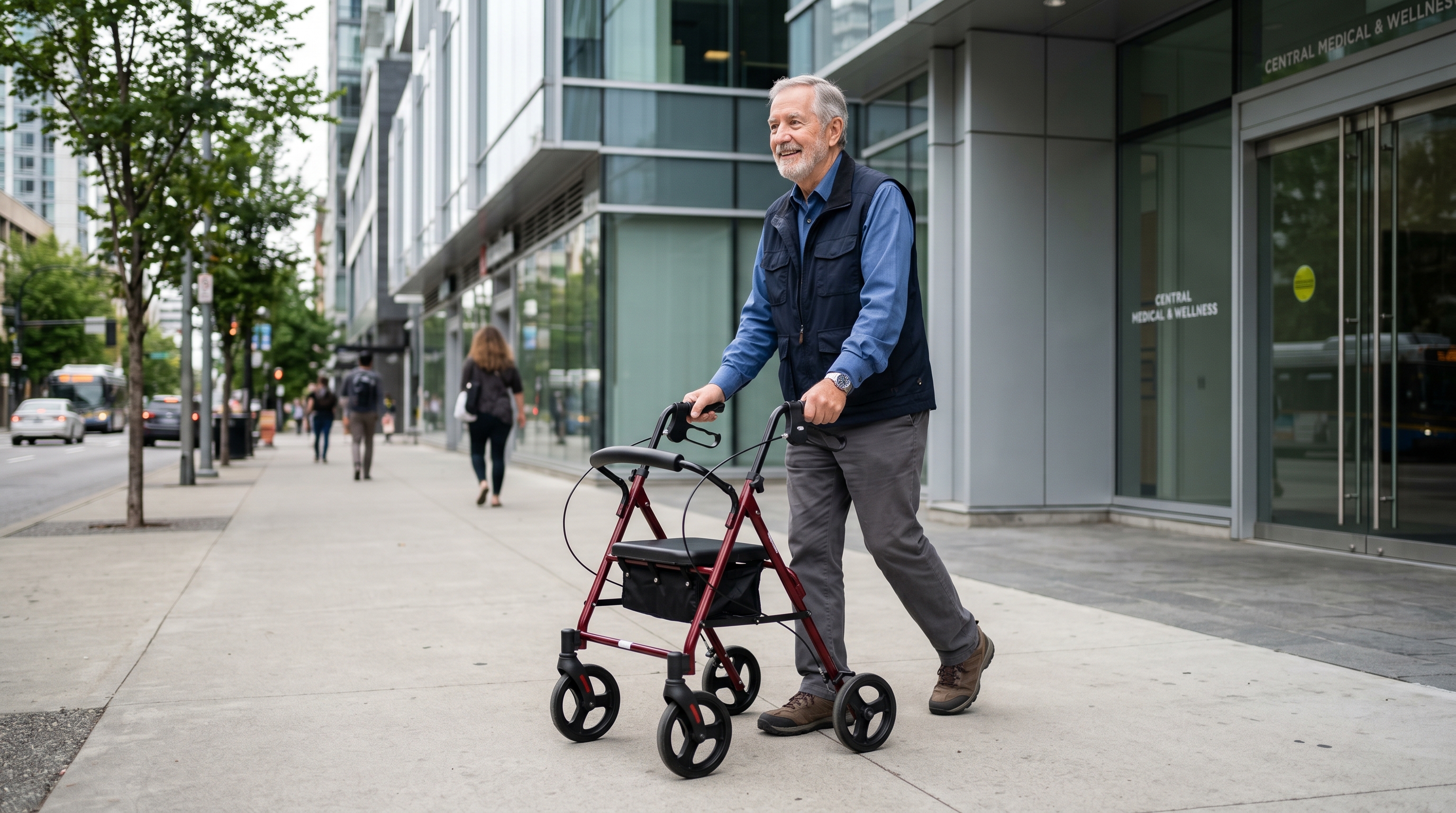
Four-wheel rollators are the most versatile option for community mobility. They roll continuously, include hand brakes, and most feature a padded seat for rest breaks. This matters enormously in Canadian conditions: outdoor terrain, longer walking distances, and winter navigation all favour a rollator's stability and adaptability.
- The EZee Life Lightweight Steel Rollator CH3017 at $209.99 CAD offers a solid starting point, with European-style design and a padded seat.
- The MOBB 3" Wheel Aluminum Rollator at $235.00 CAD comes in multiple colors and suits users who want a lighter frame.
- For users who prioritize minimal weight above all else, the EZee Life Carbon Fiber Rollator CH3018 at $995.99 CAD is one of the lightest rollators available in Canada, making it easier to lift into a car or manage on transit.
For Canadian winters specifically, the rollator's larger wheels, hand brakes, and continuous rolling motion offer a meaningful advantage over standard walkers on packed snow or wet ramps. That said, no walker fully compensates for icy surfaces. Cleats, indoor alternatives, and caregiver support remain important in severe winter conditions.
Browse the full range of walkers and rollators to compare models side by side.
How to Help a Loved One Accept Using a Walker: A Guide for Caregivers
Suggesting a walker to an aging parent or spouse is one of the most emotionally loaded conversations in caregiving. Resistance is nearly universal. It's not stubbornness. It's grief. Many seniors associate mobility aids with the loss of their younger identity, and that association is worth taking seriously rather than dismissing.
Common resistance patterns fall into a few categories. Stigma: "I don't want to look old." Denial: "I don't need it yet." Pride: "I've managed this long on my own." Each pattern calls for a different response. Stigma responds to reframing. Denial responds to evidence. Pride responds to an appeal to autonomy.
Here are conversation strategies that work.
Lead with falls, not weakness. Framing goes a long way. "I want you to have this so you don't have to depend on me" lands differently than "I'm worried you'll fall." The first positions the walker as a tool for independence. The second positions it as a response to incapacity. Most seniors respond far better to the first framing.
Involve them in the choice. Walkers and rollators now come in multiple colors, materials, and configurations. A carbon fiber rollator looks nothing like the institutional aluminum frame of thirty years ago. Go shopping together, in person or online. Letting the senior choose their own device gives them ownership of the decision. That ownership matters.
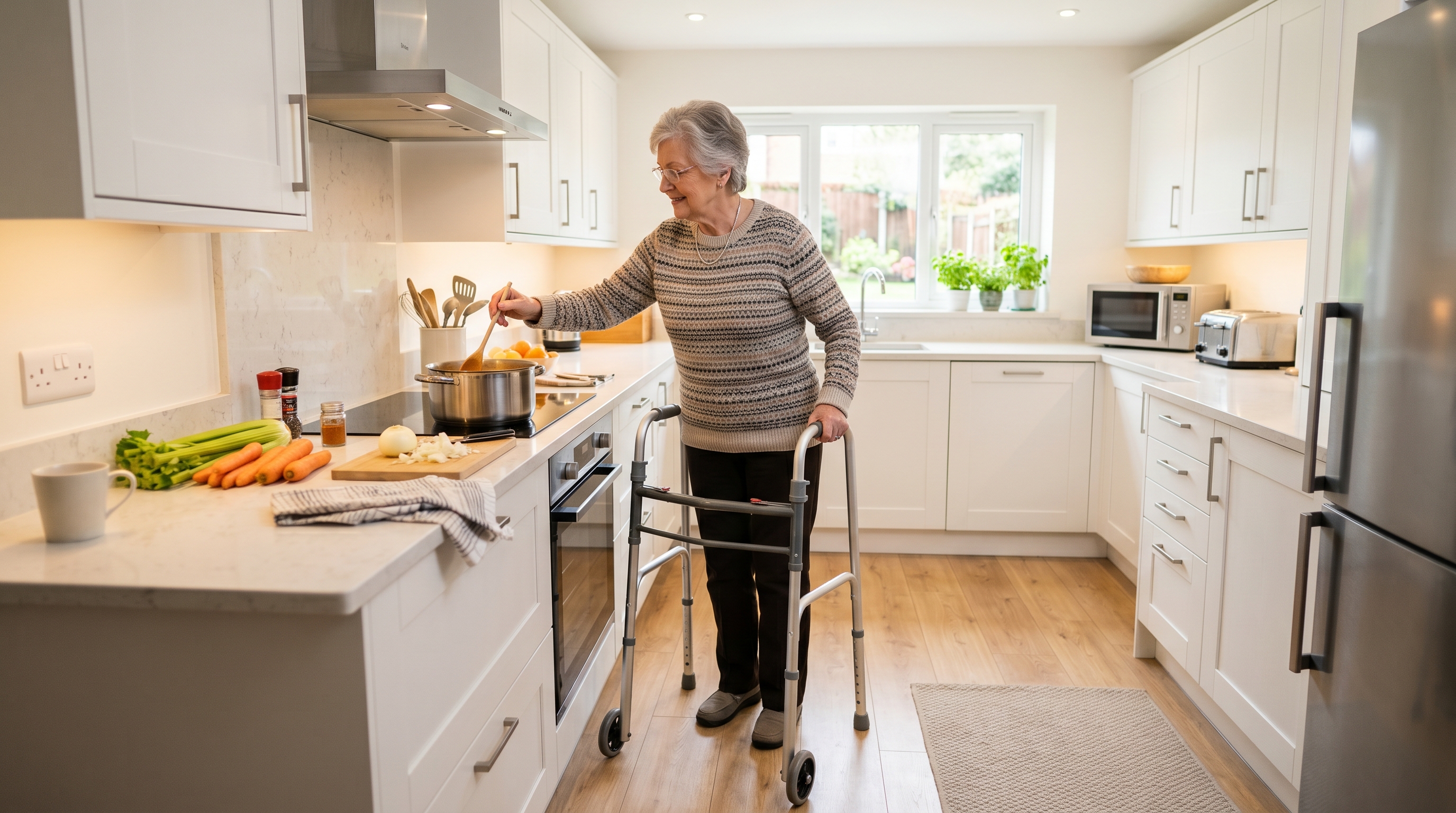
Start at home. Introduce the walker at home first. The familiarity of a known environment reduces anxiety. Once the user builds confidence indoors, transitioning to outdoor and community use becomes much less threatening.
Use timing strategically. The ideal moment to introduce a walker is shortly after a near-miss or a minor fall, when the emotional reality of risk is present. Raising the topic after a fall doesn't feel like criticism. It feels like a natural response. Avoid raising it during an unrelated conflict or when the senior is fatigued.
Get a professional involved. A family physician's recommendation carries weight that a caregiver's suggestion often doesn't. Physiotherapists and occupational therapists can assess the senior's gait directly and recommend a specific device. That professional endorsement shifts the conversation from family opinion to clinical guidance.
Government Funding for Walkers in Canada: What Seniors and Families Should Know
Ontario's Assistive Devices Program (ADP) covers 75% of the approved purchase price for eligible walkers and rollators. That's a substantial subsidy. For a rollator priced at $245 CAD, the ADP contribution reduces out-of-pocket cost to roughly $61. For higher-end models, the savings are even more significant.
The process has a few clear steps. First, the senior needs an assessment by an eligible prescriber or authorizer. For walkers, this is typically a physician, physiotherapist, or occupational therapist. The authorizer confirms the medical need and submits documentation to the ADP. Second, the senior must purchase from a registered ADP vendor. Purchasing from a non-registered retailer makes the claim ineligible, so confirming vendor registration before purchasing is essential.
ODSP recipients receive different treatment. Ontario Disability Support Program clients are eligible for 100% coverage of approved mobility aid costs. That full coverage removes the financial barrier entirely for this population.
Other provinces operate comparable programs under different names and structures. British Columbia's At Home Program, Alberta's Aids to Daily Living program, and similar provincial frameworks all offer partial or full coverage for medically necessary mobility aids. Eligibility criteria, coverage percentages, and approved devices vary by province. Check your province's health ministry website for current program details.
What many families don't realize is that private benefits often layer on top of provincial funding. Extended health plans through former employers, union benefits, and group insurance policies frequently cover the remaining portion after ADP pays its share. A benefits coordinator or insurance broker can clarify what's available.
Factory Direct Medical is a registered ADP vendor, which means purchases made through the site are eligible for Ontario ADP claims. Staff can assist with the documentation process. Explore walkers and rollators that qualify for ADP funding.
Frequently Asked Questions
What is the difference between a walker and a rollator?
A standard walker is a four-legged aluminum frame that the user lifts with each step. It provides maximum stability and weight support. A rollator has four wheels, hand brakes, and usually a padded seat. It rolls continuously without lifting, making it better suited for people with good balance who need endurance support rather than maximum structural stability.
How do I know if a senior needs a walker or a rollator?
The key factor is balance versus endurance. If the senior has significant balance impairment or is recovering from surgery, a standard walker offers more support. If the senior's balance is reasonably intact but they fatigue quickly or need to rest on walks, a rollator with a seat is often the better fit. A physiotherapist or occupational therapist can assess gait directly and make a specific recommendation.
Does Ontario's Assistive Devices Program cover walkers?
Yes. Ontario's ADP covers 75% of the approved cost for eligible walkers and rollators. ODSP recipients qualify for 100% coverage. You need a prescription or authorization from an eligible healthcare provider (physician, physiotherapist, or occupational therapist) and must purchase from a registered ADP vendor. The application process is straightforward once you have an authorizer in place.
What features should I look for in a walker for a senior with balance issues?
Prioritize: adjustable handle height (wrist-level when standing), non-slip grip material, tip condition (rubber tips wear out and must be replaced), frame weight (lighter is easier to maneuver), and fold-ability for transport. For balance-challenged users specifically, a wider frame and lower center of gravity add stability. A physiotherapist can measure correct handle height precisely.
Can walkers be used outdoors in Canadian winter conditions?
Standard walkers with rubber tips perform poorly on snow and ice. Four-wheel rollators handle outdoor winter conditions better, particularly on packed snow and wet ramps, because of their larger wheels and continuous rolling motion. For icy surfaces, no walker fully compensates: ice cleats attached to footwear and a companion or caregiver are important additional safety measures. Many seniors use a rollator outdoors and a standard walker indoors during winter months.
How do I get my elderly parent to accept using a walker?
Lead with autonomy, not safety. Frame the walker as a tool for staying independent longer, not as a response to weakness. Involve them in choosing the device. Let them pick the color, style, and features. Start indoors in familiar surroundings. Timing also matters: the period shortly after a near-miss or fall is often more receptive than a cold conversation. If family conversations aren't working, ask their physician or occupational therapist to raise the topic directly.
Where can I buy a walker or rollator in Canada?
Factory Direct Medical has supplied Canadians with medical equipment since 1996. The walkers collection and rollators collection offer a range of price points from $75 to $995 CAD. As a registered ADP vendor, purchases are eligible for Ontario government funding. Free shipping is available on qualifying orders.
Find the Right Walker for Your Situation
Mobility walkers give Canadian seniors something genuinely valuable: the ability to stay in their homes, manage their own routines, and move through the world on their own terms. The research is clear on fall prevention. The funding is available. The technology has improved significantly.
Ready to explore options? The walkers collection covers standard and folding frames from $75 CAD. The rollators collection includes lightweight and carbon fiber models suited to Canadian outdoor conditions. Factory Direct Medical has been a trusted Canadian supplier since 1996, offers free shipping on qualifying orders, and is a registered Ontario ADP vendor.
Written by the Factory Direct Medical Expert Team. Factory Direct Medical has supplied Canadian families with medical equipment since 1996.


